Previous Governors of Tennessee
Governors who previously held office in Tennessee, with term dates and party affiliation.

Bill Lee was elected Governor of Tennessee in 2018 and re-elected in 2022. A farmer and businessman with no prior political experience, he ran as an outsider. He has focused on education reform, workforce development, and criminal justice reform.

William Edward Haslam is an American billionaire businessman and politician who served as the 49th governor of Tennessee from 2011 to 2019. A member of the Republican Party, Haslam previously served as the 67th mayor of Knoxville, Tennessee. Aside from politics, he is also notable as the majority owner of the Nashville Predators National Hockey League (NHL) franchise, after he purchased the team from Herb Fritch, in July 2025, and is also co-owner of a minor league baseball team, the Knoxville Smokies.

Philip Norman Bredesen Jr. is an American politician and businessman who served as the 48th governor of Tennessee from 2003 to 2011. A member of the Democratic Party, he was elected in 2002 with 50.6% of the vote and re-elected in 2006 with 68.6%. He served as the 66th mayor of Nashville from 1991 to 1999. Bredesen is the founder of the HealthAmerica Corporation, which he sold in 1986. He is the last Democrat to win and/or hold statewide office in Tennessee.

Donald Kenneth Sundquist was an American businessman and politician who served as the 47th governor of Tennessee from 1995 to 2003. Prior to his governorship, he represented Tennessee's 7th congressional district in the United States House of Representatives from 1983 to 1995. He was a member of the Republican Party.

Ned Ray McWherter was an American businessman and politician who served as the 46th governor of Tennessee, from 1987 to 1995. Prior to that, he served as the speaker of the Tennessee House of Representatives from 1973 to 1987, the longest tenure as Speaker up to that time. He was a member of the Democratic Party.
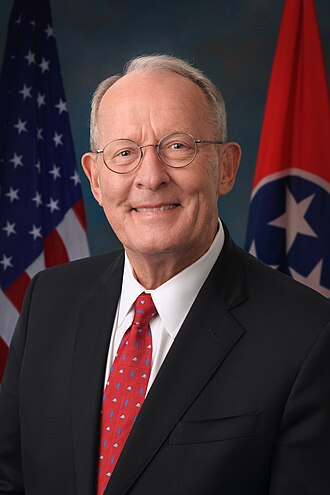
Andrew Lamar Alexander Jr. is an American politician, academic administrator, and attorney who served as a U.S. senator from Tennessee from 2003 to 2021. A member of the Republican Party, he was previously the 45th governor of Tennessee from 1979 to 1987 and the 5th United States Secretary of Education under President George H. W. Bush, serving from 1991 to 1993. During his tenure at the Department of Education, he supported the implementation of the "America 2000" education reform initiative.
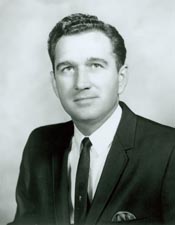
Leonard Ray Blanton was an American businessman and politician who served as the 44th governor of Tennessee from 1975 to 1979. He also served three terms in the U.S. House of Representatives, from 1967 to 1973. Though he initiated a number of government reforms and was instrumental in bringing foreign investment to Tennessee, his term as governor was marred by scandal over the selling of pardons and liquor licenses.

Bryant Winfield Culberson Dunn was an American businessman and politician who served as the 43rd governor of Tennessee from 1971 to 1975. He was the state's first Republican governor in fifty years. Dunn was an unsuccessful candidate for a second term in 1986, losing to Democrat Ned McWherter. He remained active in the Republican Party and the medical field from the end of his term as governor until his death.

Earl Buford Ellington was an American politician who served as the 42nd governor of Tennessee from 1959 to 1963, and again from 1967 to 1971. Along with his political ally, Frank G. Clement, he helped lead a political machine that controlled the governor's office for 18 years, from 1953 to 1971.

Frank Goad Clement was an American lawyer and politician who served as the 41st governor of Tennessee from 1953 to 1959 and from 1963 to 1967. Inaugurated for the first time at age 32, he was the state's youngest and longest-serving governor in the 20th century with 10 years of service, having been elected to the governorship in 1952 and re-elected in 1954 and again in 1962. Clement owed much of his rapid political rise to his ability to deliver rousing, mesmerizing speeches. His sermon-like keynote address at the 1956 Democratic National Convention has been described as both one of the best and one of the worst keynote addresses in the era of televised conventions.